‘Delicatessen, the only band currently doing anything interesting with a tune. They are a blast of refreshingly foul breath on a becalmed sea of soporific, retro sludge, a genuinely twisted talent’ reads one review, circa 1995/1996.
They say of The Velvet Underground that, while they weren’t wildly popular or successful in their day, everyone who heard them started a band. What I can say of Delicatessen’s Skin Touching Water is that while I’ve never met someone who had heard of this album, everyone who hears it and really engages with it comes to love it. Why this band remains so obscure is a genuine mystery, though the quote above offers some suggestions. The band’s unique mix of surrealism, folk, alternative rock and noise was a mile out of step with the prevailing thrust of UK music in the mid-’90s. But you can take my word for it that this album is an absolute gem. You can trust me. Or not, I’m just a liar.
On a personal note, this album found me, like many others I consider favourites, thanks to Adelaide guitar maestro and art teacher Tony Burnett (Visitors, Chancery Lane, Mala Lama and more), who slipped me the CD one day when I was probably making my way to the oval for marks-up. I take a strange pride in being one of the oddballs it seemed entirely appropriate to give an album of mid-90s caustic, gothic, Lynchian cowboy grunge, and I can’t thank Tony enough for making that call. He, and whoever was curating the music section at the local library, have probably ended up being the most important musical influences in my life, speaking as an only child (with no siblings to steal records from) living in Australia at the end of history.
There’s precious little information about the band Delicatessen or the scene from which they emerged available for a 21st-century internet lurker. On Skin Touching Water at least the band consists of songwriter, vocalist and multi-instrumentalist Neil Carlill accompanied by Craig Bown, Pete Capewell and Stuart Dayman. Carlill’s songs and delivery come across as sinister, surrealist reports from the far side, the rhythm section like an otherworldly lounge band. The obvious comparison is to Nick Cave’s work around this period, and the music shares a similar outsider’s take on gothic Americana. But while Cave relied more heavily on direct use of folk, blues and country music forms and stylings, Delicatessen weaves that sound into something genuinely unique: the abrasiveness and loud-quiet-loud dynamics of ’90s alternative rock at one moment, angular acoustic guitar and bossa nova-inspired brushes grooves the next. The production is extremely effective, largely raw and unprocessed except for select moments, such as on the single C.F. Kane, where the entire mix is washed with ear-splitting distortion. It’s a totally unique production approach which untilises little in the way of the tropes of the period.
What we can say, and the quote at the beginning of this post aludes to this, is that the album came about during the height of Britpop, and it seems that the band was received somewhat as a reaction to or holdout against that particular movement.
I’m actually quite fond of Britpop music, given that I really engaged with it years after its moment had passed. As a result I listen to it on its own terms rather than as the musical wing of the Cool Britania moment which saw the arrival of New Labour, giddily optimistic postmodern nationalism and a hedonistic popular culture. I take these criticisms and I often find myself making similar ones of my own generation’s music. Nonetheless, I like the tunes.
It is worth, however, considering Delicatessen in this context. There’s no ‘godlike’ anthems (aside from perhaps the chorus of Classic Adventure), jovial sing-alongs or ironic posturing. There’s a dead-eyed seriousness to Skin Touching Water, a sinister swagger.
The album’s first three tracks are both incredibly strong and a real encapsulation of the sonic world on Skin Touching Water. I’m Just Alive is a mesmerising adventure in guitar layering, underpinned by a glorious distorted organ loop. Carlill offers a number of surrealist profundities which stick in your brain, in this case ‘I’m just alive, I’m just alive, I’m just a life, she seems to understand‘. (I’m taking a guess at lyrics as they are nowhere to be found online and quite cryptically written inside the album cover)
I can imagine that the album’s second track, C.F. Kane, would be many people’s favourite. A slithering blues-adjacent acoustic guitar riff begins the song, followed by more surrealist horror from Carlill (bloody cheeks, cut their lips off, slice their kids up, the pain shoots up my sleeve or has my arm another wrist?). This makes way for a relatively melodic chorus, with the lyrics referencing Citizen Kane over a relatively cheerful IV to I chord progression. The moment which really elevates the song comes after the second chorus where, seemingly out of nowhere, the song explodes into some of the most caustic, squealing distortion you can imagine. Carlill’s almost cartoon-villain ‘all I see is energyyyyyyy’, which precedes this moment, is humorously chilling. As far as songwriting goes it’s a shockingly bold left turn.
My personal favourite is the third track Zebra/Monkey/Liar. Lyrically it seems to reference predator/prey dynamics using the ‘laws of the jungle’ as a metaphorical vehicle. The song is essentially through-composed, with four distinct sections following each other with no repetitions. The climax of the piece is the final ‘movement’, a return to the distortion of C.F. Kane, but this time with Carlill doing his best Jim Morrison croon. Personally, I hold this song up as the gold standard of non-conventional songwriting, both because of how effective of a journey the song is, but also because it’s done in less than 3 mins 30 seconds.
Other highlights on the album include You Cut My Throat, I’ll Cut Yours, which juxtaposes driving intense verses with subdued choruses featuring slide guitar and the album’s final track If She Was Anybody Else, which is another fascinatingly off-kilter song featuring a wonderfully weird string hook and some really bold harmonic moves. I’ve often wondered if the song was partially assembled from samples, so surprising is some of the shifting harmonies. Looking back, song anticipates the sound of bands like Deerhunter by over a decade.
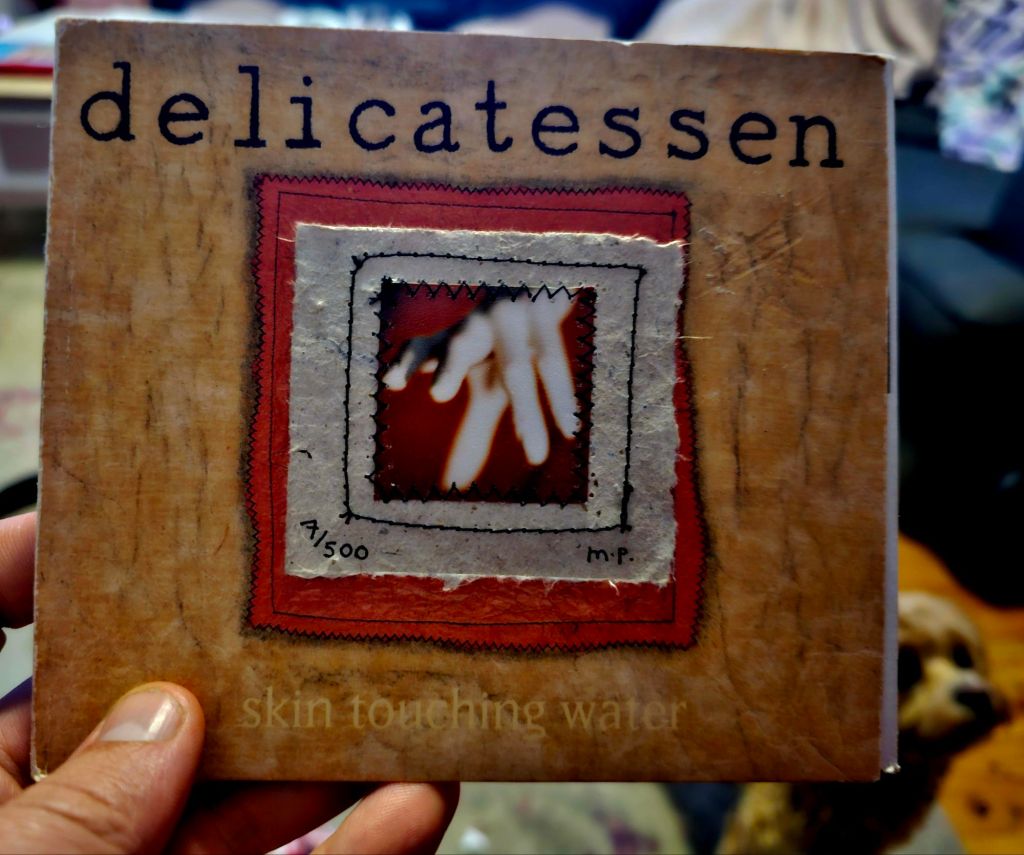
I recently found a copy in a used bin at a local record store. It felt like finding the Holy Grail. For a moment I was returned to those afternoons with my friends trawling used sections and the local library for hidden gems, letting happenstance be the curator of our music tastes. We have streaming and personalised playlists now, and yet Delicatessen remain obscure. If the All Seeing Algorithm is going to insist on consuming and curating everything, the least it could do is give Skin Touching Water a second life. It’s a remarkable record.

 referent
Leave a comment