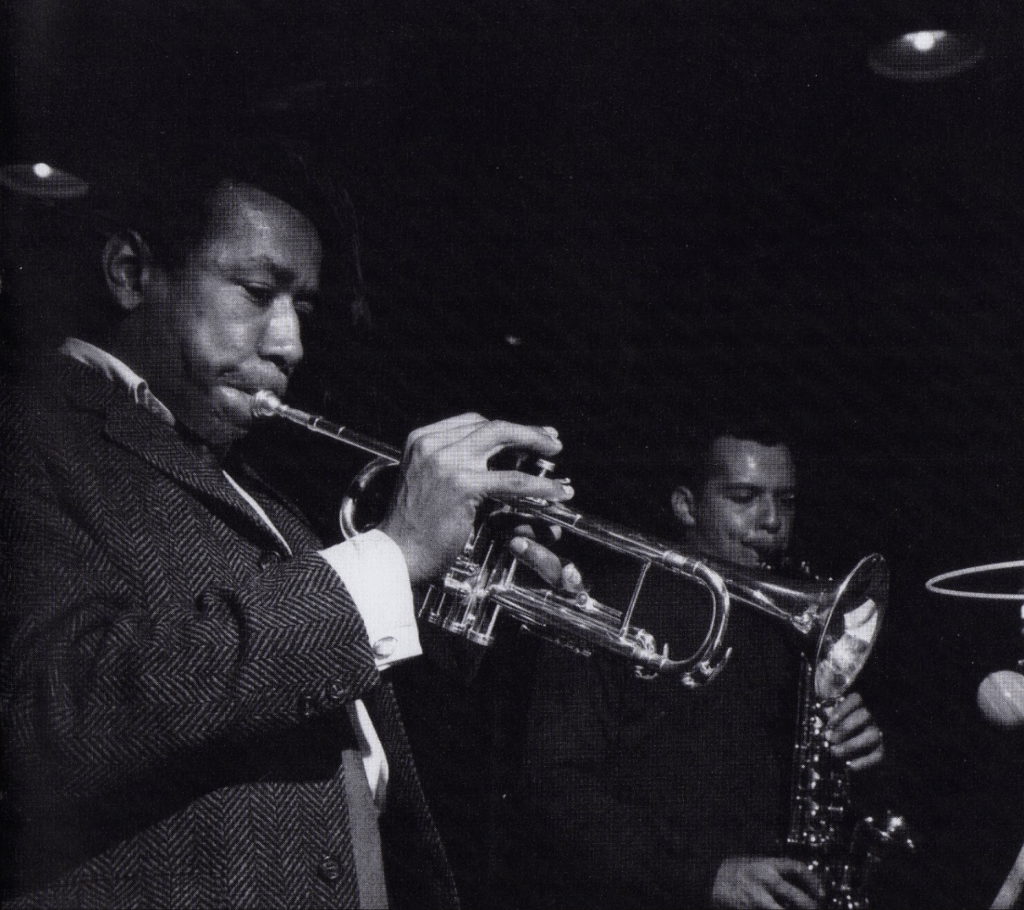
Something I’m intending to do with this blog is write a little about albums or tunes I’ve come to love over the years, with a particular focus on music which might have slipped through the cracks or fallen off the radar.
‘Tom Cat’ by Lee Morgan is one such album. The story regarding the sequencing of releases of Morgan’s albums has been told elsewhere, but I’ll summarise here. By the time this album was recorded in August 1964, Morgan had become a significant commodity as far as the Blue Note record label was concerned thanks to the success of his album The Sidewinder and the use of its title track in a Chrysler commercial in 1963. A fact that’s difficult to grapple with today is that the tune The Sidewinder cracked the Billboard Top 100, a tune which is undeniably catchy and joyous, but also features some pretty exploratory improvisation from Morgan and Joe Henderson especially, at least by the standards of ‘mainstream’ music charts.
The result of this success is that albums such as Tom Cat and the celebrated Search For The New Land were shelved. In the case of New Land the delay was only from 1964 until 1966, but in the case of Tom Cat the album remained unreleased until 1980, eight years after his death. For this reason alone I can understand why Tom Cat isn’t often regarded as an important marker in the progression of 1960s jazz, but these kinds of conversations about the historical importance of an album, whether the music within represents a progression for the artists or something novel… these things don’t matter so much for me.
Onto the actual music… the first thing to note is that the lineup is a kind of alternate reality Jazz Messengers with a front line of Morgan, Jackie McLean and Curtis Fuller, with McCoy Tyner, Bob Cranshaw and Art Blakey in the rhythm section. This invites some comparisons to Blakey’s ’60s groups, in particular what I consider the two classic Jazz Messengers lineups: the Morgan, Wayne Shorter, Bobby Timmons, Jymie Merritt group who made albums such as The Freedom Rider and A Night in Tunisia, and the group featuring Freddie Hubbard, Curtis Fuller, Shorter, Merritt or Reggie Workman and Cedar Walton on piano who made the classic Free For All among a number of classics. The group Morgan assembled for Tom Cat was a who’s who of Jazz Messengers alumni, including Jackie McLean who appears on a few mid-’50s Messengers albums. The one exception, and a major figure in the Tom Cat ensemble is pianist McCoy Tyner. Two things to note here: Firstly, Tyner and Messengers member Cedar Walton in the ’60s were not an universe away from each other in terms of style. I find their hard-bop inside/outside approaches quite similar at points. Secondly, Tyner did appear with Blakey on the latter’s A Jazz Message (not an official Messengers release), along with Sonny Stitt… a great record! I personally find Blakey, Tyner and Walton have deeply authoritative and assured time feels, and the dialogue they have at that level is always thrilling for me.
Lee Morgan was, of course, part of Jazz Messengers lineups which featured composers with styles which pointed in quite different directions regarding the trajectory of jazz in the 1960s. Benny Golson and Bobby Timmons (who wrote Moanin’, perhaps the tune most identified with the Jazz Messengers), brought a distinctively gospel-infused sound to their writing, particularly on their most well known tunes. On the other hand Wayne Shorter, who Morgan played alongside in both the Jazz Messengers and on Shorter’s own albums (including his debut record as well as Night Dreamer, arguably Shorter’s best), was perhaps the composer who most defines the ‘mid-’60s sound’, with his blending of iconic melody writing and harmonic innovations. On Tom Cat, Morgan was at the helm of a Jazz Messengers-like ensemble and we get to hear his own compositional voice in this context.
The result is something probably closer to Timmons and Golson, but there is an undeniable influence of Shorter in the mix. The blues was never far from Morgan at any point of his career and it is certainly present in his writing here: the tune Tom Cat itself broadly follows a blues form, while Twice Around is essentially a contrafact of Nat Adderley’s ‘Work Song’.
Yet there are a few traces of the modal harmony that Morgan would have been exposed to playing Shorter’s compositions with Blakey’s band, in addition to his experience playing on John Coltrane’s ‘Blue Train’, the title track of which uses the same technique Morgan uses on Tom Cat: using the form and chord changes of the blues, but harmonising the horns in that distinctively modal way using scale tone triads.
These techniques, combined with what was becoming Morgan’s distinctive melodic sensibility, make pieces like Tom Cat and Rigormortis really memorable and effective.
Jackie McLean plays with notable clarity on this recording. One thing I admire about his playing is the completeness of his phrases; ideas emerge fully formed and structured yet without the dispassion that at times crept into someone like Sonny Rollins’ more motivic solos. There’s a certain way that McLean’s clarity of thought is a great support role for Morgan and his more exploratory moments, much like Herbie Hancock does on other Morgan records (Hancock the Sideman was a master in this period of building a solo from the smallest cell of an idea and carrying it through all its permutations and potentialities. See live recordings of the Miles Davis Second Great Quintet from 1965 to 1967… sometimes the music disintegrates before Hancock puts the pieces back together again).
McCoy Tyner at this period is more known for his work with John Coltrane’s Classic Quartet, where he was painting with huge brush stokes of quartal harmony and colour. On Tom Cat he seemingly returns to his style from a couple of years before, such as on albums like Reaching Fourth… the pentatonic runs and stomping left hand 5ths are there, but there are lots of blues and bebop-like passages also. Yet it’s worth noting that in the same year as Tom Cat, Tyner recorded his Duke Ellington tribute record and was appearing on Joe Henderson and Shorter albums. It’s important to remember that even though Tyner’s ’60s style, broadly defined, has been digested so thoroughly by subsequent piano players that a mention of his name calls up a specific system of chord voicings and scales, he was in fact a versatile player who could adapt to the setting he found himself in.
Art Blakey’s role is an interesting one on Tom Cat. I recall Richard Cook and Brian Morton writing in their Penguin Guide to Jazz that Blakey showed a unique ability to understand and accompany Thelonious Monk’s music. He plays a similar role here on Tom Cat, bringing all his iconic fills and press rolls, but always being ‘in’ the music, be it the feel and time changes of Twice Around or the double-time moments of Tyner’s Twilight Mist. It’s fun to hear Morgan and Blakey trading solos, with Blakey deploying many of his iconic lines, knowing Morgan has probably traded fours with these exact drum phrases before.
Considering it with all of the aformentioned context Tom Cat feels like a document of ‘high hard-bop’, one of the brightest moments of a jazz style which blended complex multi-part writing of the kind we hear on Oliver Nelson’s Blues and the Abstract Truth, while retaining and emphasising memorable melodies and danceable rhythms. Within a few years the music was venturing into more ‘free’ terrain or going electric in the form of jazz fusion. For this reason it’s understandable that an album like this in 1980 would have seemed unremarkable. But as I’ve hopefully described, Tom Cat is a wonderful collection of great writing, tackled by some of the true greats of the music.

 referent