Anders Jormin: ‘In Norwegian they say if you’re good at reading scores… reading music… you read like a moose’. Paul Motian: ‘… what’s a moose got to do with reading music?‘ Bobo Stenson: ‘and in Swedish we say you “read like a fox”… what do you say in English?‘ Motian smirks: ‘Read like a motherf****r!‘. All three erupt in laughter.
Taken from the Motian in Motion documentary, it’s a laugh-out-loud window into what it might have been like to hang with the great drummer like Bill Evans and Scott LaFaro did in the famous photograph below, taken at the foot of the stairs down to the Village Vanguard.
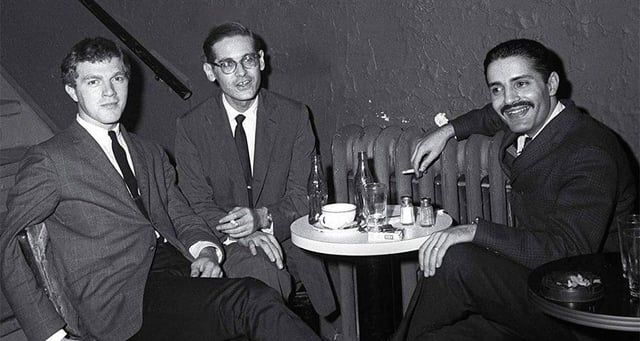
While that photo was taken on June 25th 1961, the afternoon and evening when the Bill Evans Trio recorded the material which would make up Waltz for Debby and Sunday at The Village Vanguard (what many consider the pinnacle of the piano trio format), the earlier anecdote occurred in April 2004 when the Bobo Stenson Trio recorded Goodbye… two bookend moments from the life of perhaps jazz music’s most singular voice on the drums.
Misterioso, the album in focus here, sits at the midway point between these two scenes… 1986 to be precise. It features a somewhat short lived quintet, but one which would both set the template for Motian’s own music for the remainder of his career and announce the arrival, to international audiences, of two major figures of late 20th and 21st century jazz in Bill Frisell and Joe Lovano. If I had to summarise it briefly… Thelonious Monk-infused, guitar-driven modern jazz, with duelling, muscular tenors and Motian the drummer and composer at the peak of his powers.
Background
I was lucky enough to experience Motian’s music more or less chronologically. This is probably one of the reasons I love this record so much… the evolution and expansion of my listening was soundtracked by the evolution of Motian’s style from the 1950s through to the early 2010s, and Misterioso at that time felt like a real answer. Coming into jazz in the 2000s, the music of that era felt somewhat in stasis. Few of the living legends were breaking new ground… Wayne Shorter and his 2000s quartet being the obvious exception. Among younger players on the major labels there was a certain post-Marsalis formalism, often padded out by the obligatory Radiohead or Nirvana cover. The question I kept circling was where the vitality, spirit and modernist ethic of the ’60s and ’70s had gone.
Of course, that was only the beginning of my listening journey, and there were indeed a great many musicians still carrying that torch… albeit not always on the bigger labels, and therefore not always in Australian record shops. But in Motian’s ’70s, ’80s and ’90s work I found part of the answer. Here was a body of music with the three qualities that ultimately made me love jazz as a whole: a dialogue with the history of the music, the presence of genuinely distinctive musical voices and something like a telos… a sense of striving for the next thing, and the next thing after that.
Motian and his ensembles had all three in spades. A deep reverence for the tradition, yes, but crucially a dialogue with it rather than a museum-piece treatment… unmistakable players, from Motian himself… perhaps the most easily identifiable drum sound and approach in the history of the music… to Frisell, Jim Pepper, and later figures like Kurt Rosenwinkel and Chris Potter… and, of course, the shock of the new. His bands were always distinctive, from each other and from the music as a whole: the bass-less trio with Frisell and Lovano, which felt in some strange way like a continuation of the telepathic interplay of the Bill Evans Trio… the Electric Bebop Band(s), with two tenors and two guitars, refracting 1940s bebop through the intensity of jazz-rock fusion but the polyphony of ragtime… the On Broadway groups, perhaps his most romantic ensembles, re-imagining show-tune standards… the boldly adventurous Trio 2000 with Masabumi Kikuchi, featuring some of Chris Potter’s most compelling solos. And, of course, the ’80s Quintet featured on Misterioso.
Waltz For Debby was one of my first purchases, reading about it in the frayed Penguin Guide to Jazz gifted by my teacher and subsequently finding it in the $10 bin. As a pianist and drummer it was a revelation… the harmonic world of Evans which one could devote a lifetime simply trying to emulate and then… this drummer. As many variations and sidesteps of the ‘swing beat’ as any of the big name drummers I was told to listen to, but there was a certain deference to the music. While fellow greats like Tony Williams muscle and grapple with the music, Motian seemed instead to coax and charm. It pointed to a whole different approach.
Next was Keith Jarrett’s American Quartet. I had, expectedly, first come to Jarrett via the Standards Trio, particularly Whisper Not, and the deep dive commenced. Reading about the group… avant-garde modernism blending gospel, ‘world music’ (it was the ’70s) and the musical world of Ornette Coleman… I couldn’t imagine how the Motian I was introduced to on …Debby would operate in this context. Fort Yawuh seemed an obvious choice to start, given it was recorded live at the Village Vanguard twelve years after Waltz for Debby. A lot of it went over my head at the time, but it was only after I had properly digested both the Bitches Brew Miles Davis band and the Forest Flower / Love-In Charles Lloyd group (featuring Jarrett) that I had enough of a reference to understand the music. For a wonderful summary of Jarrett’s music with the American Quartet, see Ethan Iverson here: https://ethaniverson.com/shades-of-jazz-keith-jarrett-charlie-haden-paul-motian-dewey-redman/ . As for Motian, his style had dramatically changed to suit the band and this era. Many pieces have a straight 8ths ‘jazz-rock’ feel that defines jazz fusion of this period, but Motian is always restless, always exploring. There’s is rarely two consecutive bars with a backbeat, like we might hear from Al Foster with Miles Davis. In retrospect you can hear in Motian’s sound the solidifying of a certain latin or even ‘world music’-tinged straight 8ths approach to contemporary jazz drumming which would be taken up by European drummers on the ECM label such as Jon Christensen or Michal Miskiewicz.
Perhaps the most important stylistic addition to Motian’s approach during the years with Jarrett was the use of rubato, put simply the playing of ‘free time’. There are many moments across the American Quartet’s repertoire where we hear the ensemble dabbling in this concept. Without doing too much extensive research, it feels like this particular style of rubato playing owes a bit to what Ed Blackwell and Billy Higgins were doing on Ornette Coleman’s Science Fiction in the earlier part of the ’70s. This was a major stylistic innovation for Motian as it would drastically shift the democratic make-up of ensembles he was part of… where once he was the grounding member of the Bill Evans Trio, with Jarrett his push and pull, timbral washes and generally contratian musical attitude would pull the safety net from the ensemble and give the music an impressionistic and deconstructed quality. It (his rubato style) would come to be the first thing associated with Paul Motian’s own music, though his deep sense of time never left.
Side note: there’s a hilarious anecdote in Ethan Iverson’s eulogy of Motian about his experience playing with him and Charlie Haden, when Iverson was particularly struggling with Motian’s contrarian approach during a Haden solo. When Iverson explained his struggles to Haden, the great bass player and decades-long Motian collaborator said’ ‘You were listening to Paul Motian?! Never listen to Paul Motian!’ … they must have been a long way from the drummer I first heard on Waltz for Debby.
In the decade between ’72 and ’82 Motian sporadically released albums under his own name while still working with the American Quartet. From what I can tell these were not regularly working bands. Conception Vessel involved members of the Jarrett group including the leader himself, a Sax-Bass-Drums trio with the Ornette-associated Charles Brackeen and David Izenzon (from the oft-forgotten Live at the Golden Circle albums with Coleman) among other excellent recordings.
Misterioso
This brings us to the Paul Motian Band/Quintet. What makes this group special is the combination of three factors: the solidification of Motian’s mature style, his emergence as a composer of evocative, alluring melodies and the arrival of a group of younger musicians who have subsequently become giants of the music, in particularly Joe Lovano and Bill Frisell.
Misterioso begins with the title track, a Thelonious Monk standard which Motian would frequently revisit, perhaps most memorably on his mid-’90s trio album Sound of Love. It’s hard not to hear Monk’s playing in Motian’s approach here… where Monk would frequently return to the melody of his pieces when accompanying, Motian dances around the feel of the piece: a playful medium swing. Though Motian was in the midst of a period of some of his most exploratory drumming, it is notable that this take of Misterioso is some of his most grounded and embedded. Motian noted in a number of interviews how much he treasured his few or perhaps single time he played with Monk; he would later record many versions of Monk’s music including on the Monk in Motian album from 1989. The two tenor saxophonists contribute great solos: Pepper draws heavily on the blues tonality, floating across Motian’s feel and having some great interactions with Frisell. Lovano contrasts this with firey double-time lines in a short but impressive solo which makes way for one of my favourite Bill Frisell solos. Having listened to nearly 40 years of subsequent Frisell music we can of course hear many Frisellisms but it is particularly the use of dissonant clusters and broken intervals which make the solo work so well. It feels like he channels Monk in those moments.
Abacus on the other hand is a great example of the exploratory dimension to Motian’s playing during this period. A three and a half minute free-time blast, featuring Motian duets with Frisell, Lovano, then a trio of Pepper, Lovano and Motian, it demonstrates less of a rubato style and more of a ‘wall of percussion’. Though this approach to drumming has a history dating back to the ’60s, Motian’s version of this is compelling: in the case of Rashied Ali or Sunny Murray, pioneers of rubato, impressionistic and ‘melodic’ drumming, that approach was fundamental to their sound as a whole. In the case of Motian we hear glimmers of the history of the music of which Motian had already been an important part… post-modern in the best way.
Gang of Five and Dance are played in a similar vein, in the former Motian plays a furious fast swing, a style he would further develop in his Electric Bebop Band in the ’90s, while the band drifts across his beat in a way reminiscent of Ornette Coleman’s Lonely Woman, while Dance introduces it’s knotty theme in free time, before Motian reintroduces the fast swing for the saxophonists. What’s remarkable is the deep interconnectedness of the band throughout so much open and free playing… this was road-tested music as this was Motian’s working band at the time.
The music of Thelonious Monk is revisited on Pannonica, a favourite of Motian and Lovano as both would play it again on their own albums in the ’90s. The highlight is an extended solo from Motian in which it’s hard to not make crude parallels with the soloing style of Monk himself: there’s a surface level simplicity and childlike quality to their approaches, the complexity of which becomes immediately apparent when one tries to imitate or transcribe them. Like Monk, Motian developed by this point a radical and deeply personal vocabulary and we hear this clearly on Pannonica.
The album ends with a solo saxophone performance from Pepper on Johnny Broken Wing, showcasing the beautifully emotive playing of Pepper and of Motian the composer. Motian’s emergence as a composer was another key feature of this period and he would bring material of his own to many albums he would feature on for the rest of his career. His pieces often sit somewhere between folk song and blowing tunes, serving as the canvas for his ensembles. Some of them, like It Should’ve Happened a Long Time Ago are achingly beautuful. On Johnny Broken Wing it is Pepper alone who closes the album, fitting as it was his solo which began proceedings on Misterioso.
Soon after this Motian would dissolve this particular quintet in favour of his trio with Lovano and Frisell and the groups with Charlie Haden, Dewey Redman from the American Quartet and then up-and-coming pianist Geri Allen (the Allen-Haden-Motian trio considered by many to be one of the great piano trios). Pepper would sadly pass away in 1992, leaving a significant body of recorded work dating back to the late ’60s.
Motian would soon turn his focus to the canon with his On Broadway and Electric Bebop Band projects. Misterioso in this context really appears as a high water mark of Motian’s forward-looking groups, after which he looked to apply the approaches he had developed to the Great American Songbook and the Bebop tradition. While these works are fantastic and well worth revisiting, it is Misterioso which stands tall as a statement of Motian the composer and as a true great at the art of jazz drumming.
 referent
Leave a comment