The Laptop Years
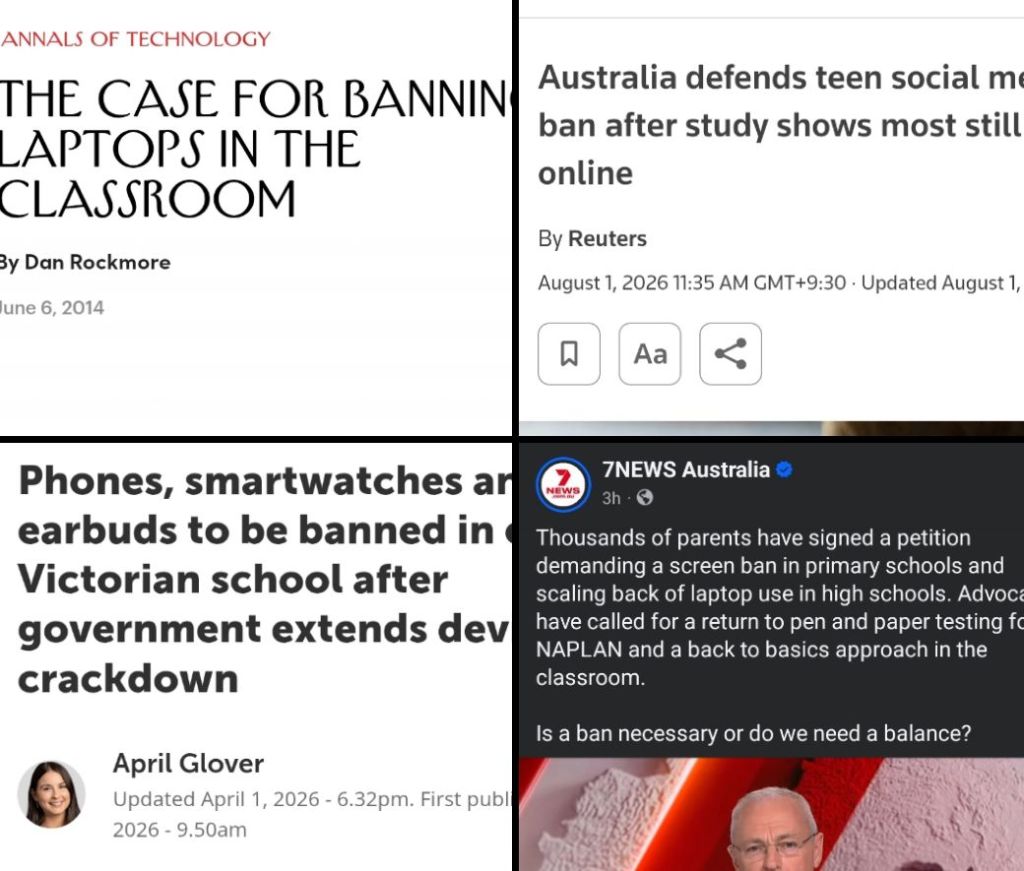
It feels as though the Laptop Years might finally be drawing to a close.
If I had to put a date on their beginning in Australia, 2008 seems about right. Kevin Rudd’s Digital Education Revolution was underway and the laptop was, in Rudd’s memorable formulation, “the toolbox of the 21st century“. One-to-one laptop programs spread rapidly through schools. Wireless campuses, SMART Boards, Moodle, ClickView, eventually BYOD… all of this arrived so quickly that within a few years it was difficult to remember schools without it.
Open nights changed accordingly. Parents could be shown connected classrooms, students sitting behind identical screens, teachers moving between the whiteboard and whatever learning management system the school had bought into. The laptop program became part of the sales pitch… proof that a school was modern and connected, ready for 21st Century Learning.
Almost twenty years later the mood is very different.
Jonathan Haidt has found an audience far beyond psychology departments and anxious parents. Here in South Australia, Peter Malinauskas has met with Haidt and signalled an intention to take many of his recommendations seriously. Phone bans, screen limits and various other restrictions that would have sounded borderline reactionary fifteen years ago are now fairly ordinary policy positions.
It suddenly feels possible to look back on the Laptop Years as a period rather than just what schools are like in 2026.
What I remember most clearly from the beginning of that period isn’t really the technology anyway, it was the confidence surrounding it. The future seemed unusually settled and schools had to adapt: Students needed “21st century skills“. Technology wasn’t going away and we couldn’t be left behind.
These sorts of phrases were everywhere and, after a while, stopped really functioning as arguments. They didn’t need to. They were thought terminating cliches disguised as descriptions of reality.
There was always an asymmetry to all of this. New technology required surprisingly little evidence before being rolled out across entire systems… optimism, momentum and a sufficiently convincing story about the future usually did the job. Anyone expressing reservations, on the other hand, was to express them along with something like a longitudinal study.
I remember teachers making observations which now seem almost embarrassingly obvious. Students seemed more distracted. It was becoming harder to sustain attention across a lesson. Increasingly you weren’t just teaching a room of thirty students, you were competing with thirty browsers, messages, games, YouTube tabs and whatever else was sitting a click away. That in a time in which education was becoming increasingly focused on the teacher-student relationship, giving teachers trauma informed, restorative practices, they were also asked to be the police for students’ ever deepening information-communication devices addiction, setting that very relationship off on the back foot.
These weren’t particularly sophisticated critiques of technology, they were teachers noticing things.
Yet there was a remarkably consistent response whenever these concerns were raised: we need to teach them HOW to use the technology. Or technology isn’t going away. Or the old favourite… we can’t be left behind. A general organisational and administrative attitude which had, in retrospect, an incredibly rose-tinted view of the trajectory and the future.
It was this moment, when the fairly commonsense prediction was made that putting a networked screen in front of every child for six hours a day might have some immediate and long-term consequences for attention, that these phrases did their best work. The observation itself didn’t really need to be answered. The person making it could instead be placed on the wrong side of history.
Importantly, none of this was confined to grumbling teachers alone.
Sherry Turkle’s Alone Together appeared in 2011, almost perfectly timed for the world I’m describing. Turkle was hardly a technological reactionary. She had spent decades at MIT studying our relationships with computers, and much of her earlier work had been fascinated by the possibilities of digital life. What increasingly concerned her was what happened when computers escaped the computer room and became permanently attached to us.
Her argument wasn’t really about “screen time” in the contemporary sense. She was interested in social development… children growing accustomed to divided parental attention, adolescents preferring messages which could be edited and controlled to the awkwardness of conversation, the disappearance of solitude and boredom. The difficult bits of social life… silences, misunderstandings, waiting, being left alone with yourself… were precisely the things permanent connectivity made increasingly easy to escape.
This was 2011.
And Turkle wasn’t alone. Franco “Bifo” Berardi was approaching the same transformation from a more radical and critical theory angle. In Precarious Rhapsody he describes the acceleration of information as producing an almost pathological mismatch between the amount of information arriving and the human capacity to process it. We cannot possibly absorb the expanding stream coming through computers, phones and screens, yet increasingly feel that we must follow it all if we are to remain “efficient, competitive, victorious”.
The result, for Berardi, was not simply distraction. Multitasking and what he called “hypertextual attention” were beginning to deform the sequential character of thought itself… the ability to stay with an object, follow an argument from beginning to end, pursue a linear strategy without being pulled into another informational context. I have found the concept of the hypertextual to be highly useful in thinking through why phones and laptops impact not just mental health, raw attention, but also literacy, critical thought and creativity.
Mark Fisher, who I must always reference, returned to this passage repeatedly in lectures because it described something he increasingly recognised around him and in himself. Fisher became preoccupied with compulsively checking Twitter, the inability to maintain concentration and the strange experience of knowing that these habits were destructive while remaining caught inside them. Alongside Jodi Dean’s idea of communicative capitalism, Berardi helped him describe a world in which communication was no longer merely something we did. It had become a continuous demand upon attention. Fisher seemed increasingly concerned in what he was observing in his students circa-2009 and afterwards. Younger millennials, who potentially knew a pre-smartphone world. Today’s school student was born into the world of the iPhone 5.
It’s strange reading all of this now because so much was already visible. Turkle was worrying about conversation, solitude and social development. Berardi and Fisher were worrying about information overload and the erosion of sustained attention. Teachers were making their much less theoretical observations about what was happening in classrooms. Yet the laptops kept arriving.
And then, predictably enough, education began responding to the consequences.
As attention became harder to sustain, attention became another thing schools needed to teach. Digital citizenship. Executive functioning. Wellbeing programs. Various programs for self-regulation, organisation and responsible technology use.
This isn’t particularly surprising… institutions respond to the problems sitting in front of them. What they are much worse at is travelling backwards through the sequence of decisions that helped produce those problems.
Educational reform has a geological quality to it. Initiatives rarely disappear completely… they settle over one another like sediment. The learning platform remains while the new wellbeing framework is placed on top of it, followed by the executive-functioning program, the digital citizenship curriculum, another professional learning session, another framework addressing some problem which didn’t seem quite so urgent ten years earlier. After a while nobody can quite remember what the ground looked like.
There are a couple of bits of popular culture I keep thinking about in relation to this:
Cherrybomb, the 2009 film with Rupert Grint, is not exactly Rebel Without a Cause… but it is basically telling that very old story. Bored teenagers, sex, drugs, stupid decisions, the attraction of doing something destructive simply because nothing else is happening.

Watching it now though, what stands out is the phones. Text messages are already everywhere. The old adolescent boredom/hedonism story is still there, but something is beginning to consume the boredom itself. The characters are permanently reachable. Impulses can immediately become plans. Information travels instantly through the group.
I’m probably giving Cherrybomb more theoretical weight than its makers ever intended, but it now feels like a remarkably good artefact of that moment… an old story about teenage boredom being swallowed by an emerging communications environment which never really switches off.
Then there is Stranger Things.
The walkie-talkies have always amused me. Obviously children did use walkie-talkies in the late ’70s and early ’80s, so there’s nothing particularly anachronistic about them. But the sheer narrative work they perform in the show feels very contemporary. The characters are almost permanently contactable. They split up and immediately communicate across town. Information moves between groups in something approaching real time.

In other words, the walkie-talkie becomes a kind of historical smartphone.
By the 2010s we’d become so accustomed to permanent communication that it was apparently difficult to imagine childhood without it. To make a pre-mobile-phone childhood comprehendible to a contemporary audience, Stranger Things gives the kids the walkie-talkie as substitute, handily also nodding to the era.
In 2009 film-makers were already noting that mobile communications were changing the texture of adolescent interaction. By the late ’10s we couldn’t imagine what a world without it was like.
The Laptop Years are already being rewritten as another story about “screen time”, digital distraction and social media harm. Fair enough… those things matter. But something more interesting risks disappearing with them: the extraordinary confidence with which the whole project was undertaken in the first place… the certainty that the future had already been decided.
The assumption that technology would inevitably transform everything and that the responsibility of schools was not really to ask whether a particular technology improved education, but to work out how quickly it could be incorporated. Critics weren’t necessarily wrong; they were simply behind.
Which brings us, inevitably, to AI and the similar confidence and enthusiasm with which we have embedded it into the everyday lives of students.
AI has become the representative technology of the present and already the language surrounding it is difficult to distinguish from what came before. Schools must adapt. Students need to be prepared for the jobs of the future. We can’t pretend it isn’t happening. We can’t afford to fall behind. The script is identical.
Perhaps in this case, the AI bubble has been so inflated that to some extent these statements might end up being true.
But I can’t help wondering what schools will be teaching ten years from now to compensate for whatever consequences currently seem too speculative to take seriously. What new frameworks will be placed over the top. What new professional learning sessions will explain how to repair some capacity we didn’t realise we were eroding when we embedded AI into the word processors students used to think with.
I don’t doubt that education will adapt. Education is extraordinarily good at adapting.
What I’m less certain about is whether anyone will remember the teachers raising those questions now… or whether, by the time their concerns become conventional wisdom, as we see today with smartphones and laptops, they too will have disappeared somewhere beneath the sediment.


Leave a Reply