95. Aphex Twin – Syro
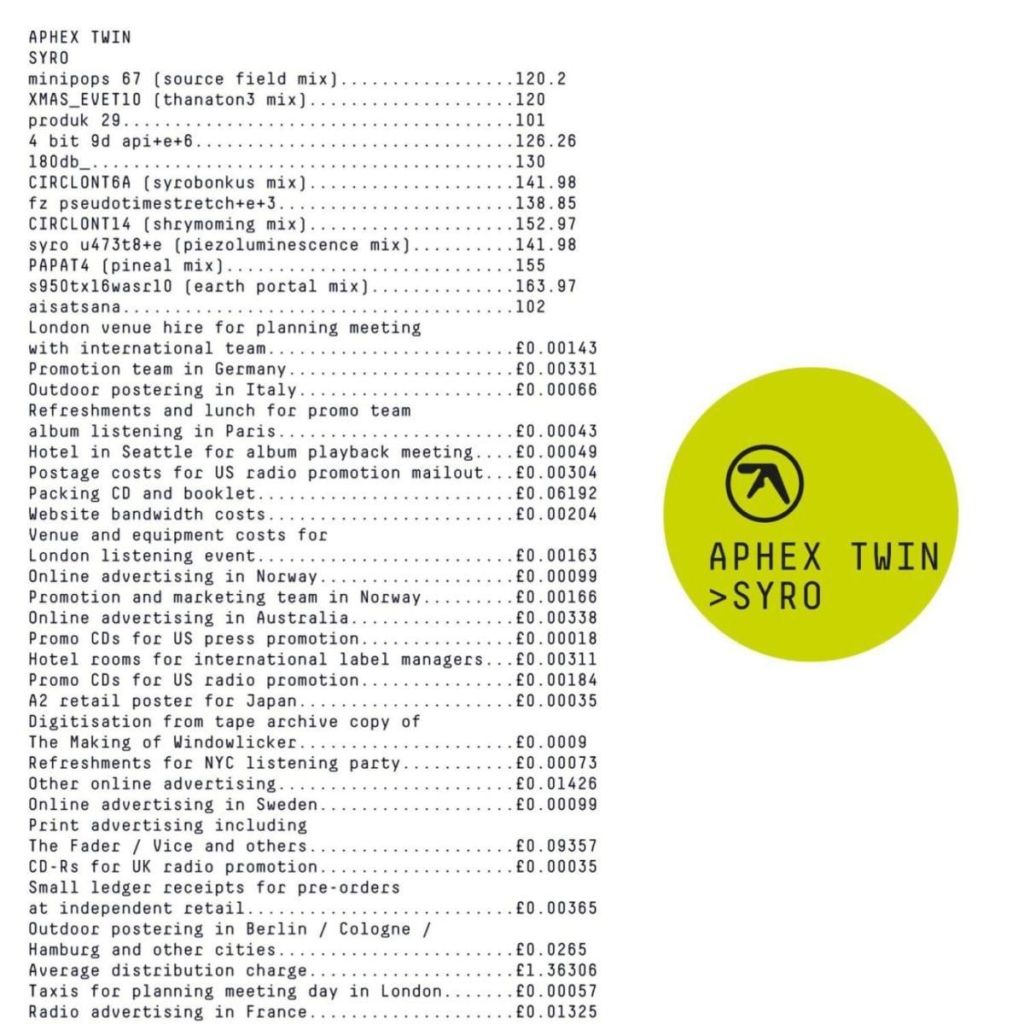
95. Aphex Twin – Syro
There’s a certain impetus, when writing about electronic music, to discuss it in terms of how groundbreaking and/or zeitgeist-capturing it is. It’s probably only with the retrofuturism of the last decade or so, with genres like vaporwave and other ‘nostalgia as aesthetic’ genres, that this sense of stylistic churn and progress… of electronic music always heading somewhere… has become less central to the conversation.
Syro is certainly not the ‘of the zeitgeist’ album from Aphex Twin. I’m fortunate enough that this doesn’t matter much to me: a bit too young to have experienced the impact of the Richard D James Album, too naive of electronic music history to know what is and what isn’t a cliché.
What I can say is that this album really blew me away… it was the moment that I really got what was special about Aphex Twin.
Part of what makes Richard D James and Drukqs stand out from much of the electronic music which preceded them is the level of intricate detail given to the music. Any criticisms levelled at these genres in regards to repetition or over-simplicity certainly don’t apply to these Aphex Twin records.
For me, Syro contains as much intensity and detail as those previously mentioned, but adds a kind of large-scale compositional virtuosity. Where an earlier Aphex track might pair an incredibly detailed drum part with a string melody or synth line, Syro often has three or four densely intertwined things happening at once, each with its own little internal details and movements. The pieces are often long and varied and yet feel like they are organically evolving throughout, rather than simply moving from one idea to another. I find myself still discovering new moments to appreciate after years of listening to it.
On a totally personal note, I also appreciate the aesthetic ambivalence of it. As much as I really enjoy other ‘IDM’ artists like Boards of Canada, I find that their work can veer towards a cloying sentimentality, even if their whole vibe and reputation sets you up to expect a good dose of nostalgia. As much as Syro is an album where Aphex Twin is refining his approach rather than breaking entirely new ground, to me he still sounds very intent on world-building. Syro is an album that I think rewards you for investing in it, rather than bringing your own notions to it or employing it as a soundtrack to something else.
94. Jaki Byard – Hi-Fly
Jaki Byard is a wonderfully difficult pianist to place in the spectrum of modernists vs traditionalists. In the ’60s you had Herbie, Chick, McCoy, Evans, even Cedar Walton who were eschewing parts of the language and approach of stride, bebop etc. You had Andrew Hill and Cecil Taylor who were at times dismissing it wholesale. Yet, you had Hank Jones, Tommy Flanagan, even Oscar Peterson who kept these traditions intact throughout the ruptures of the late ’50s and ’60s, in addition to the singular voices like Thelonious Monk or George Shearing. Even though this is all a gross oversimplification, fans of the music would get where I’m coming from with this… and yet there sits Jaki Byard.
Byard seemingly had the whole history of the piano available to him and he puts it all to good use on Hi-Fly. But what is most impressive and enduring about the album and his music generally is that despite being able to play convincingly in a wide range of styles, he still has a sound. There’s something about his touch on the keys, heavier and more bombastic than most, about his fluid yet authoritative time feel, sometimes giving the impression he’d rather be without his accompanying bass and drums… whether it’s on this record or some of my other absolute favourites from this period like Sam Rivers’ Fuchsia Swing Song 👀 , Eric Dolphy’s Outward Bound or a number of Charles Mingus records… you can tell it’s Byard at the keys as much as you can Herbie or McCoy.
There are so many wonderfully enjoyable tracks on this album. The standards Lullaby of Birdland and Blues in the Closet are given quite faithful renditions… Blues… is possibly the most up-tempo version I’ve heard featuring some quite angular trades between Byard and La Rocha, before an extended bowed solo from Ron Carter. The title track and Tillie Butterball contain some incredibly modern, cascading lines from Byard that have clearly inspired contemporary piano great Jason Moran. Meanwhile the programmatic, suite-like Here to Hear and Byard’s authoritative version of ‘Round Midnight contain some wonderfully sensitive moments amongst some dynamic, violent chordal passages which you can sense attracted the ears of Charles Mingus.
The piece which perhaps best summarises the album is Excerpts from Yamecraw, originally a James P Johnson stride solo piano piece, which Byard and co walk through the history of jazz up to that point. Byard flits between stride, bebop, avante-garde and more, Ron Carter is at his deepest, bluesy best and this might be my all time favourite Pete La Rocha recording.
93. Blonde Redhead – La Mia Vita Violenta
93. Blonde Redhead – La Mia Vita Violenta
I won’t make a claim here that this is the best Blonde Redhead album. Paradoxically, they probably channel their NYC-scene, Sonic Youth-adjacent sound more clearly on their debut album, whilst already melodically and vocally hinting at their later dream-pop-inspired work. Their noisy rock songwriting would become more honed on the next two albums, Fake Can Be Just As Good and Melody of Certain Damaged Lemons. But La Mia Vita Violenta found me at just the right time, when I was searching for angular, experimental songwriting that wasn’t afraid to be unrefined, unbalanced and ambitious. That’s really what this record offers.
I had a good laugh when reading through some discussions and rankings of Blonde Redhead albums. Album Of The Year .org had La Mia… in last place, with the tagline ‘mediocre, forgettable, boring’. Of course that’s the one I have as my favourite record, the contrarian drip that I am.
I must protest, however. This album has a real sense of exploration as the band layers enigmatic, interlocking riffs and melodies amongst noise and percussion, with great vocal performances, particularly from Kazu Makino, who is at the most abrasive point of her career.
It does sound like they were a little thin on solidly worked-through material for an album-length release. What I love, though, is that they didn’t fall back on some of the jammy, krautrock-inspired moments of their debut album, which would have certainly added minutes to the run time, and instead opted for experimentation. At points it’s a brutal listen; at others, like on the five-minute sitar excursion Harmony, it’s oddly soothing.
It makes me miss that sweet spot in music-industry history when bands could be trusted with some studio time and re$ources to just churn something out. It’s not always refined, it might not always work out, but it’s real and exciting. And if you’re in that same phase yourself, it can really set a fire under you.
92. Finn Brothers – Finn
The first Finn-related project in this top 100. Cards on the table, I adore the work of Neil and Tim Finn… I had the opportunity to see the reformed Split Enz earlier this year and Crowded House a couple of years prior and these were real bucket list experiences.
Finn sits in an interesting place in the Neil and Tim continuum. Crowded House had just finished the tumultuous Together Alone album cycle, completing a run of four CH albums which have, to speak without undue grandiosity, become the soundtrack of the Gen X/elder Millennial generations at least in New Zealand and Australia. Meanwhile Tim, who by the early ’90s had released four acclaimed solo albums post-Split Enz, had just released the album Altitude with the folk-supergroup ALT (which was one of the all-time vinyl discount bin finds for me).
From this artistically transitional moment for both brothers is born Finn. I can imagine, at the time, there may have been expectations of Woodface 2, the third Crowded House album on which Tim had joined as a member. But, in fact, Finn is an unusually loose and minimalistic album. Arrangements are sparse and unfold organically, ideas and motifs are rarely crowded out by other ideas and motifs. While it’s such an easy-listening album, there are more than enough quirky and left-field moves to keep me coming back.
The singles on the album stand easily alongside the countless hits the brothers have written. Suffer Never is a lightly psychedelic Neil-driven tune which hints at some of his writing over the next decade, calling to mind the riff from Everything Is Good For You from the CH Best-Of and Souvenir from his Try Whistling This solo album. I adore the way the chorus steps back dynamically and texturally, a really masterful example of minimal arranging. Only Talking Sense has some harmonies from the brothers and, as a result of this and the conga percussion accompaniment, recalls a little of Woodface. Angel’s Heap is a Tim-driven acoustic ballad and is an absolute gem, to me one of the great coming-of-age songs, beautiful in it’s abstraction and collage-like series of images.
Across the rest of the album are a number of wonderfully quirky pop songs: Eyes of the World, Bullets in my Hairdo and Niwhai are the more upbeat, energetic songs featuring stomping drumming and percussion from Tim. Even when they play with bombast the arrangements are minimal, sometimes some strumming, other times some rhythmic electric piano. The remaining ballads really soar: Mood Swinging Man is a swaggering, bluesy confessional from Tim about his emotional state/s… he’s always been a fantastic singer on this kind of material. And Last Day of June is a magnificent piano ballad from Neil with a chord progression to kill/die for.
The other element on the album is what Neil has called ‘Pacific kitsch’… some of the instrumentation, the use of a sample from a Cook Islands church choir, some of the Pacific Islands imagery scattered throughout. As Neil said at the time, ‘I wouldn’t make any grand claims for it being rootsy or authentic. It’s the kind of Pacific that us white Tee-ahmutu boys probably first associated with, a nod to that nostalgic view: Bali Ha’i, shell mirrors and all that. It’s valid for us, it’s what we grew up with.‘ Although the brothers are musically descendants of that great ‘rock’ music tradition which feels rooted in the British Isles, at the end of the day their music is inextricably tied with the land of the long, white cloud and, in addition the the music’s minimal and portable instrumentation, gives the album a distinctive sonic flavour.
91. Sam Rivers – Fuchsia Swing Song
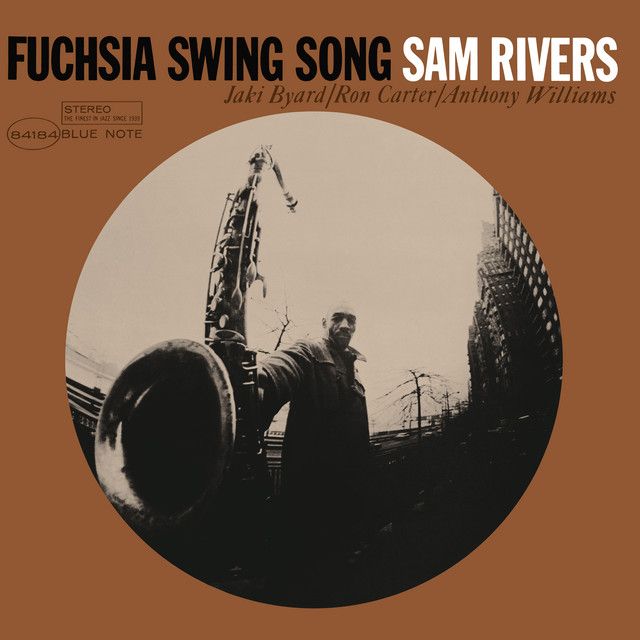
One of my all-time favourite subgenres of music is ‘inside-outside’ jazz from the ’60s. These were artists who were still operating with many of the musical tools they received from predominantly bebop and hard bop, but were looking to push its boundaries and expand its possibilities. For me, this is a wonderful sweet spot in the evolution of jazz music, as players began to experiment with the idea of playing ‘free’… that is eschewing rigid harmony and form structures, and instead placing an emphasis on maximal improvisation and ensemble interaction. During the ‘inside outside’ period, there are still tunes, still somewhat established musical roles, but these are being stretched, subverted, expanded. Fuchsia Swing Song is one of the great examples of this period of music, one of the several iconic albums of this style put out on Blue Note Records.
Two notable facts which contextualise the recording: the bass-drums duo of Ron Carter and Tony Williams had been in variations of the Miles Davis Quintet for over 12 months, the group having just settled on Wayne Shorter and become the ‘second great quintet’, and were just over a month away from recording E.S.P… all that is to say that the chemistry between them was strong and they prove to be a dynamic engine room on this recording. The other notable fact is that Fuchsia Swing Song was recorded the very next day after John Coltrane’s A Love Supreme sessions, in the same room, the Van Gelder Englewood Cliffs studio.
There is really interesting inter-band dynamic which gives this album real fire and drama. Rivers was an important early mentor for Tony Williams, first hiring him when he was thirteen, and reportedly they had played a lot of this material together years before. There are moments when you feel Williams giving Rivers both the deference and the provocations he would reserve for Miles Davis… dropping out entirely underneath Rivers on Cyclic Episode before returning in incredibly interactive form, chopping up the time and responding to River’s unpredictable phrasing. On the other hand, there is a real tension between the styles of Jaki Byard and Williams… Byard is much more impressionistic with the time than someone like Herbie Hancock, making it difficult for Williams to grab any particular rhythmic motif. To me this doesn’t harm the music at all, it just adds to the drama as you hear two extremely distinctive and belligerent (in the best way) masters try to figure each other out. The moment they come together on Luminous Monolith towards the end of Byard’s solo, digging into a half time shuffle groove before Williams explodes back into the burning swing feel, is truly cathartic.
Rivers is immense throughout. One can’t help but think of him in the context of the other big tenor-playing modernists of the period: Coltrane, Shorter, Henderson, and then perhaps John Gilmore, Archie Shepp and Charles Lloyd. For me, he sits comfortably alongside and somewhere between Joe Henderson and ’60s John Coltrane… the muscularity of Henderson with the intensity and exploratory nature of Coltrane. And yet his sound is so distinctive. When I hear him on sideman recordings such as Bobby Hutcherson’s Dialogue, he is immediately identifiable… the coarse tone, the abstract phrasing, the ability to have glimmers of R&B, post-bop and ’60s-style free jazz within a single melodic phrase.
Fuchsia Swing Song has so many wonderful little moments… the Rivers solo on Ellipsis, where he continually threatens to disappear into the free-jazz stratosphere, being pulled back to earth by Byard’s grounded comping, before eventually taking off together with Byard stabbing at the keys like Andrew Hill… the drum solo, also on the same tune, which disappears into nothing before the band snaps back into action for the head-out (I’ve tried researching whether this was a tape edit, such is how sudden the ensemble entry is… it appears to be legit!)… the moment Rivers emerges from the drum solo on Luminous Monolith to take a second solo, where Byard, Carter and Williams engage in some truly diabolical accompaniment… and let’s not forget the entire performance of Beatrice, which is the most enduring composition from the album, even if Real Book readers may not be aware of the source material.


Leave a Reply